
When I went out on my own, I thought perhaps I’d lead a nonprofit. Well, I’m not doing that, but I am helping them scale consistently. My CliftonStrengths® assessment revealed that my dominant Belief® theme drives me to care deeply about mission-driven organizations, which explained why I felt pulled toward this space in the first place.
My trusted partner, Paul Pita, and I joined forces to help a mission-driven organization pressure test its value proposition and donor experience as it executed a thoughtful national expansion.
We were testing: if you want people to act, you have to know who you’re talking to, understand what they actually need to hear, and then ask enough questions to make sure you’re not just guessing.
Because "action" looks completely different to an individual donor than it does to a funder at an event.
Paul and I sought to listen to each stakeholder group so we could hear firsthand how each group talked about it and where the emotional center sat for each. Paul’s lens, having run a successful advertising agency and serving nonprofits throughout, was on the value proposition and what type of campaign might quicken the ramp from curiosity to action.
For me, I was listening for what they valued in the end-to-end experience. Once one of us decides to donate money to an organization, why do we do that? What are we hoping to achieve? Is it because it feels good in the moment, or because it helps us feel connected over a long period of time?
So many questions.
Our findings reinforced that their updated mission statement is landing. It grips the public faster by factually naming the deep systematic issues facing our communities today. However, that wasn't all we heard.
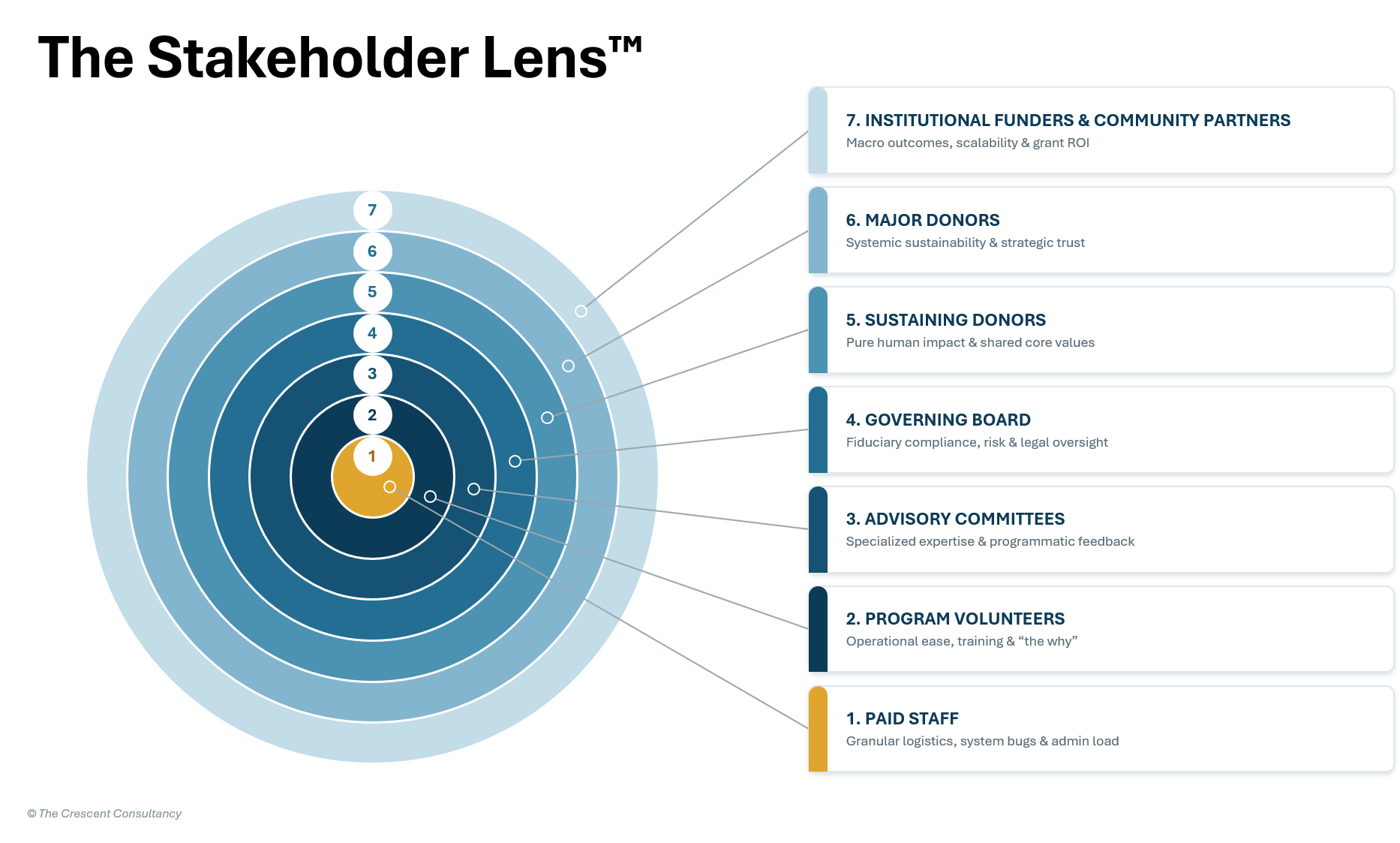
My ah-hah was that the level of detail people want changes based on where they stand; this is backed by a timeless communication theory (Roper, 1948). Now, we often use concentric circles in business, so the shape itself isn’t a new creation. But I love a good framework, and my mind immediately used those rings to map our findings.
At the inner bullseye sit leaders and staff who need the most detail, framing, training. Moving outward, it expands to social workers who must have utmost freedom to be present with clients yet be aligned and informed, then to volunteers with varying focus areas, and finally out to donors and partners who care deeply about the mission but don't want or need to know about the engine room. From that pattern of varying proximity and depth, The Stakeholder Lens™, applied here for nonprofits, was born.
But here is the real breakdown where most organizations slip up: leadership thinks they can look at a diagram of these circles and guess what people need to hear. They treat it like a quick copywriting exercise.
It isn't.
To bridge this Listening Gap™, you cannot copy-paste your way through it. You have to take the time to run deep human interviews, listen, and bring all of these voices into the same room. In this case, following interviews, we facilitated a cross-functional workshop for the donor experience journey where every stakeholder group had a seat at the table.
We also know that messages land differently depending on the context.
Some core values are powerfully evergreen. But others must fluidly adapt to changing macro and micro conditions, shifting seasons, and different geographic regions. What grips a donor during a winter crisis in the Midwest might completely miss the mark during a summer expansion campaign on the West Coast.
That is where the magic happens.
When you bring an outside expert to translate raw stakeholder listening into an actionable brand strategy, you start spotting deep underlying patterns, themes, and insights. You learn how to shape your internal daily operations to match what your external audiences care about, no matter how the environment shifts around you.
There’s science here for sure, but there’s also a reminder to leverage visuals, put your key stakeholders into groups, then pressure test what lands. Who are you trying to connect with? Who are you trying to move?
The starting point is simple: map the audiences closest to the work, then move outward.
This isn’t just for nonprofit work.
Any organization with multiple audiences has to decide what each group needs to know, feel, and do next. And once you have those insights uncovered, the real work begins: prioritizing those recommendations and building a concrete plan.
The work isn’t to guess. It’s to know what each audience needs to hear next, then build the messaging from there.