
When organizations don’t have a way to spot signals, or a shared language for them, they misdiagnose root causes and waste effort. Without Listening Architecture (how organizations listen and create a shared view), and without naming the gap between what leaders think they’re hearing and what people experience, signals stay unaddressed.
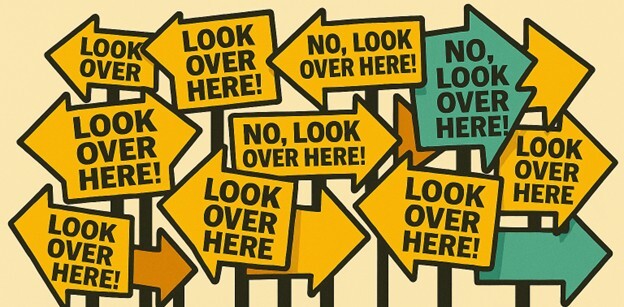
I picture signals as arrow-shaped signs saying, “Look over here!” “No, look over here!” pointing us where there's something brewing under the surface to pay attention to, like a low conversion rate despite hearing "yes" in proposal review meetings or employees with ideas who choose to stay quiet in meetings.
A shared language is the missing piece. Leaders often default to functional labels like “Marketing has attribution issues,” “Onboarding is broken,” “Human Capital isn’t retaining people.” That framing misses the real pattern. With a shared language across the organization, leaders can listen better, see what’s true, think more broadly, and focus on the changes that matter most.
Signals don’t come from one place — they show up across conversations, journey work, process reviews, data insights, and patterns in behavior. When you look across all of these, the real story becomes visible.
To get to a shared language, there are the 4 types of signals I see most often in my work: Customer, Employee, Product & Experience, Process & System. Definitions and examples are below.
1. Customer Signals - These are the clues customers give you through what they say and what they do. They show where expectations are met, missed, or quietly worked around.
Example from my work:
-
- The Signal: Consumers were calling Customer Success with detailed product questions. Website product pages had low traffic and high abandon rates.
- Why it mattered: The digital experience wasn’t meeting the needs of high intent customers who wanted deeper engagement, which put unnecessary strain on Customer Success and created missed revenue and learning opportunities.
- How we found these signals: Journey analytics and touchpoint analysis surfaced the gap between what customers wanted and where they were getting stuck.
- What we did: The team is redesigning the website to be more dimensional and experiential, staffing Customer Success with deeper expertise, and shifting simpler inquiries to AI.
2. Employee Signals - These are the lived experiences of the people delivering the work. They reveal clarity, confidence, enablement, and cultural health.
Example from my work:
-
- The Signal: A team avoided including a key stakeholder group in transformational work because they believed the leader “is not open to change.”
- Why It Mattered: Avoidance slowed cross-functional work and created escalating issues. Tiptoeing to avoid working with a team creates cultural strains.
- How We Found It: Team members shared this dynamic during interviews and working sessions, and our observations and metrics confirmed the pattern.
- What We Did: Served as a neutral third party to name the signal and make the case for inclusion in the transformation to the C-suite.
3. Product and Experience Signals - How your offering performs in the real world.
Example from my work:
-
- The Signal: Marketing and Sales promised shorter timelines to long-term customers, straining margins and manufacturing resources.
- Why It Mattered: Resources were stretched, creating delays and quality issues that were unsustainable and hurt customer relationships, brand reputation, and revenue.
- How We Found It: Patterns in rising quality issues, repeated remediation needs, and interviews across Commercial, R&D, Operations, and Manufacturing all pointed to the same root cause.
- What We Did: Defined, cross‑functionally, how to best show up as a partner — brand-aligned, clear, honest, and predictable — then reset commitments and forecasting with customers to protect quality, margins, and trust.
4. Process and Systems Signals - These reveal how the underlying machinery of the organization behaves. They show where the system helps or hinders progress.
Example from my work:
-
- The Signal: Salesforce reports weren’t trusted because each team defined metrics differently. Manual clean-up caused a lag.
- Why It Mattered: Leadership struggled to make confident decisions, and reporting delays slowed execution across Sales, Operations, and Finance.
- How We Found It: Success metric working sessions surfaced inconsistent Salesforce definitions, manual reporting preparation and handoffs, and a widening gap between what each function measured and how they used the data.
- What We Did: Aligned metric definitions across the funnel, streamlined reporting, and expanded access to consistent insights.
Bringing It All Together
Signals turn listening into something the organization can finally see and act on. They give everyone a common way to understand what’s really going on — not stacks of issues with no through-line, but a clear pattern teams can work on together.
When leaders name signals the same way across Customers, Employees, Products & Experiences, and Process & Systems, the noise quiets and the story comes into focus.
Once leaders can see these patterns, they’re able to design what should be true instead of reacting — gaining time back for employees, and customers can feel the difference.
Tip: To get started with signals, apply them to your known issues and ideas. Assign a signal to each item and notice the patterns that show you what needs attention first.